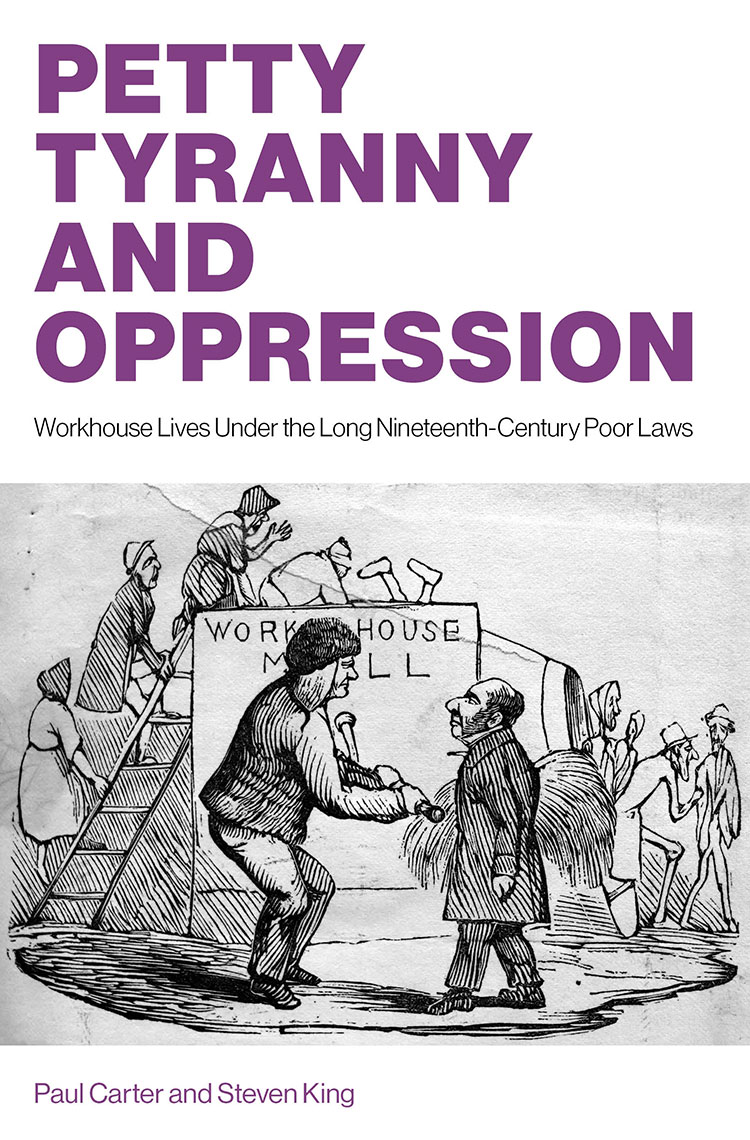
This book focuses on one of the most contentious areas of English and Welsh poor law history: the exercise of petty tyranny by officials on the workhouse poor. The book examines the period from the late-eighteenth-century crisis of the Old Poor Law, through the adoption of the New Poor Law reform in 1834, the loosening of the ‘principles of 1834’ in the 1890s, and on past the early-twentieth-century Liberal reforms, to the eve of World War I. This long chronological sweep thus examines the Old and New Poor Laws together as experienced by generations of pauper inmates.
For the first time the notion of ‘tyranny’ and its various typologies within the historical workhouse estate is set out clearly and tested against archival evidence of neglect, beatings, refusal to supply adequate relief, the denial of medical aid, and much more. While other work has centred on discipline and scandal, we instead examine the everyday experience of tyranny in the round – the potential for which was a central part of workhouse life and fed into the common fear and loathing of ‘the House’ – and the ways that it might have been contained and resisted.
The book draws on a wide archival base including pamphlets; diaries, overseers’ accounts and vestry minutes; the records of the central poor law authority; orders and circulars; punishment books; and local, regional and national newspapers. This collective archive contains many thousands of accounts of tyrannical behaviours throughout the whole of England and Wales and across the whole period.
Praise for Petty Tyranny and Oppression
‘This remarkable study makes a very significant contribution to modern social and welfare history. By systematically uncovering and exploring the myriad petty tyrannies to which welfare recipients were subject and establishing these as the foundation on which workhouse power rested, it transforms our understanding of power and resistance over centuries of welfare history. It will be essential reading for any scholar of welfare history and a staple of modern social history curricula everywhere.’ — Olwen Purdue FRHistS, Professor of Social History, Queen’s University Belfast, and Director, Centre for Public History
‘This book – the first to explore petty tyranny and oppression across both the Poor Laws of England and Wales – clearly demonstrates the potential frameworks of oppression and the different landscapes of resistance. It will be an essential volume for anyone interested in the power struggles between state and paupers as each sought to navigate the welfare system.’ — Dr Carol Beardmore, Associate Lecturer, The Open University
‘What was “tyranny” to a pauper in nineteenth-century Wales or England? Cutting dinner portions. Not answering requests. Enforcing rules capriciously. This thoughtful, careful volume finds variations from place to place, and among officials, both local and central. Steeped in words written by or about those in need, Petty Tyranny and Oppression gives a nuanced, richly sourced portrait of how the poor laws felt and functioned.’ — Gabriel Loiacono, Professor of History and Associate School Director of Public Affairs & Global Engagement, University of Wisconsin Oshkosh
Paul Carter is the Principal Records Specialist for Collaborative Projects in the Collections, Expertise and Engagement Department at The National Archives, UK. Steven King is Distinguished Professor of Economic and Social History at Nottingham Trent University, UK. With others, they co-authored In Their Own Write: Contesting the New Poor Law, 1834–1900 (McGill-Queens University Press, 2022), which won both the 2022 North American Victorian Studies Association Best Book of 2022 Prize and the American Historical Association Morris D. Forkosch Prize 2023.
This work is licensed under the Creative Commons Attribution- NonCommercial- NoDerivatives 4.0 International License. To view a copy of this license, visit http://creativecommons.org/licenses/by-nc-nd/4.0/ or send a letter to Creative Commons, 444 Castro Street, Suite 900, Mountain View, California, 94041, USA. This license allows for copying and distributing the work, providing author attribution is clearly stated, that you are not using the material for commercial purposes, and that modified versions are not distributed.
You can download the Open Access version of the book in PDF form using the button above.