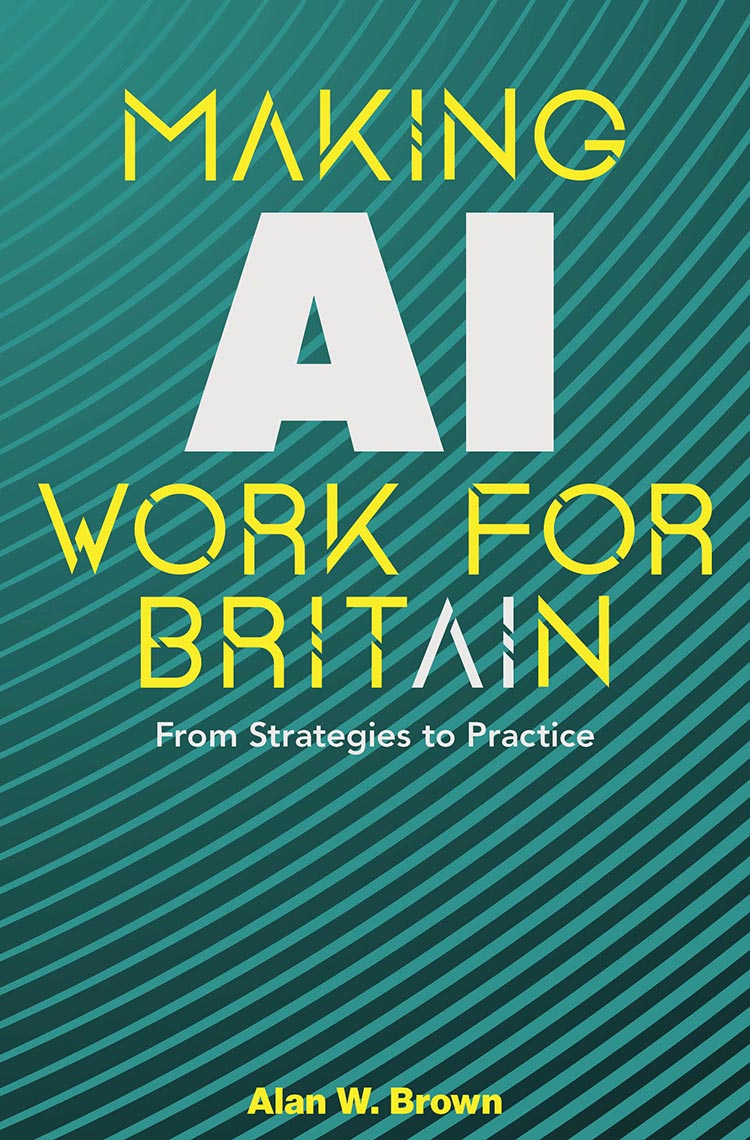
The UK government has placed AI at the centre of its plans to cut costs and improve public services. Ministers have committed to making Britain an AI superpower and have identified £45 billion in potential productivity savings from digital transformation. But this book argues that without fundamental institutional reform, these ambitions will fail – just as previous government technology strategies have failed over the past twenty years.
In 2014 Professor Brown co-authored Digitizing Government with Jerry Fishenden and Mark Thompson. That book challenged the UK to move beyond “digital as websites”, and it helped to provided important input to both the Government Digital Service and the Government as a Platform reforms. Where those institutional reforms were followed, they worked; where they were not, the government’s own data now shows the consequences.
According to the UK government’s own “State of Digital Government Review” (January 2025), only 9% of the country’s major technology programmes are rated as being on track for successful delivery. Technology programmes are 60% more likely to be rated “Red” than non-technology projects, and only 8% of public sector AI projects show measurable benefits.
Professor Brown argues that rather than being technology failures, these are institutional failures in governance, procurement, skills and accountability. “More capable AI does not fix less capable institutions,” he writes. “Strategy documents don’t transform countries. Institutions do.”
The book proposes five concrete reforms: a statutory AI Coordination Authority modelled on the OBR; outcome-based procurement using the Procurement Act 2023, with mandatory exit provisions; sovereign data infrastructure treated as strategic national investment; a three-level skills pipeline from awareness through professional capability to system leadership; and community impact assessments for every high-stakes public AI deployment.
Making AI Work for Britain is published under a Creative Commons licence (CC-BY-NC-SA) and will be free to download.
Praise for Making AI Work for Britain
‘The UK sits at a pivotal point in its potential as an AI superpower. Professor Brown has superbly captured the challenge of turning opportunity and ambition into reality, eloquently providing a roadmap to success. Government should step up and listen, or it will risk irrelevancy in this new world. We need more ambition like this.’ — Air Cdre (Ret’d) J B Crawford CBE, Former Commandant, Air and Space Warfare Centre
‘This book provides a thoughtful framework for asking the right questions about how Britain turns AI ambition into real-world impact.’ — Lord Ranger of Northwood
‘Across financial services and public data infrastructure alike, the UK excels at admiring the AI opportunity. This book does something rarer: it asks what realistic delivery actually looks like, and what has to change to make it happen.’ — Samantha Seaton, Co-Chair, UK Smart Data Council
‘Written on a bedrock of research and experience, Alan Brown’s Making AI Work for Britain is a complete and clear guide to the AI revolution. The book introduces the great opportunity AI provides to successfully navigate the next big step in digital transformation and offers an important roadmap for what the UK should do next. I highly recommend it to anyone thinking about AI strategy.’ — Dave West, CEO, Scrum.org
‘Alan draws on insights from digital transformation to identify how to introduce AI effectively into business and government. One of the most compelling visions is of AI assurance as an export industry.’ — Professor John A McDermid OBE FREng, Institute for Safe Autonomy, University of York
‘At a time of relentless digital disruption, this book focuses on the hardest problem of all: institutional change. Brown explains why AI exposes the limits of existing structures, and how organisations must fundamentally rethink how they govern, decide and deliver.’ — Tony Moretta, CEO, Digital Jersey
‘Professor Brown offers an optimistic yet pragmatic and realistic blueprint for a future national debate around how AI can reshape the future of our economy. The book provides policymakers and business leaders with a roadmap that creates a pathway to achieve the UK’s AI ambitions.’ — Tristan Wilkinson, Engagement Director, Mozaic
‘This is an excellent overview of the issues facing the UK in governing AI, developing the AI sector, growing the economy in an AI age, and integrating AI ethically and effectively into business and government. It lays out clearly all the areas to which government and industry need to pay close attention – where there are no complete answers, conclusions, or outcomes. I will be using this guide to key issues for my own research and policy work.’ — Simeon Yates, Professor of Digital Culture, University of Liverpool
‘Professor Brown’s well-researched book provides valuable insight for the informed lay reader wanting to understand more on AI’s impact in the UK. It offers a clear perspective on the UK’s current AI strategy and strengths in both a historical and global setting.’ — Dr Louise Bennett, Digital Policy Alliance Advisory Board
‘This book offers well-founded advice, innovative ideas and practical steps to help leaders and their advisers drive effective action in making AI work for the nation’ — Professor Edward Rochead FIMA, AFWES, Chair of the Alliance for Data Science Professionals
‘A timely, pragmatic, clear-eyed analysis of the UK’s AI landscape. Successfully shifts the conversation from abstract technological hype toward the gritty, institutional realities of implementation.’ — Chad Bond, Strategy and Innovation Director, Zaizi
About the author
Alan W. Brown is a professor in digital economy at the University of Exeter Business School, Research Director at the Digital Policy Alliance, and AI Director at the Digital Leaders Network, where his weekly “AI Pulse” briefing reaches more than 65,000 UK digital leaders. He is the co-author of Digitizing Government (Palgrave Macmillan, 2014), which helped guide the UK’s Government as a Platform reforms, and he has spent more than thirty years supporting large-scale digital transformation programmes – including as an IBM Distinguished Engineer and a European CTO. He is a fellow of the British Computer Society and a former fellow of the Alan Turing Institute.